


Moving House Scores Lower Than Divorce. That Is The Problem.
The stress scale everyone quotes wrong actually reveals a bigger risk than the soundbite ever did, and it is hiding in your relocation policy right now.
Every HR director has seen the line comparing relocation to divorce. It gets repeated in wellbeing decks every year, and it is not accurate. That inaccuracy has quietly let a genuine, measurable risk slip under the radar for decades.
80% Holmes and Rahe’s model implies roughly an 80 percent chance of a major health breakdown within two years once someone’s cumulative stress score passes 300 points.
The American Institute of Stress, 2025
The Stacking Effect Nobody Tracks
A single relocation rarely triggers one line on the inventory. It typically triggers eight or nine at once: change of residence, change in living conditions, change in work responsibilities, change in social activities, change of schools, change in financial state, revision of personal habits, and often a change in a partner’s employment status too. None of these look dramatic in isolation. Added together, using Holmes and Rahe’s own additive logic, they can push a relocating employee past the same 300 point danger threshold as someone navigating a divorce, without a single headline event taking place.
- The average failed international assignment costs around $311,000, and the failure rate has held near 40 percent for four decades despite far more sophisticated mobility programmes.
- ECA International’s 2025 research found compensation is the top reason candidates hesitate to accept an assignment, yet it ranks seventh among reasons assignments actually collapse.
- Roughly 44 percent of relocating partners are not fully employed in the new location, stacking identity and financial stress directly onto the household.
- Family adaptation difficulties, not budget, are now the dominant driver behind assignment breakdown across service sector companies specifically.
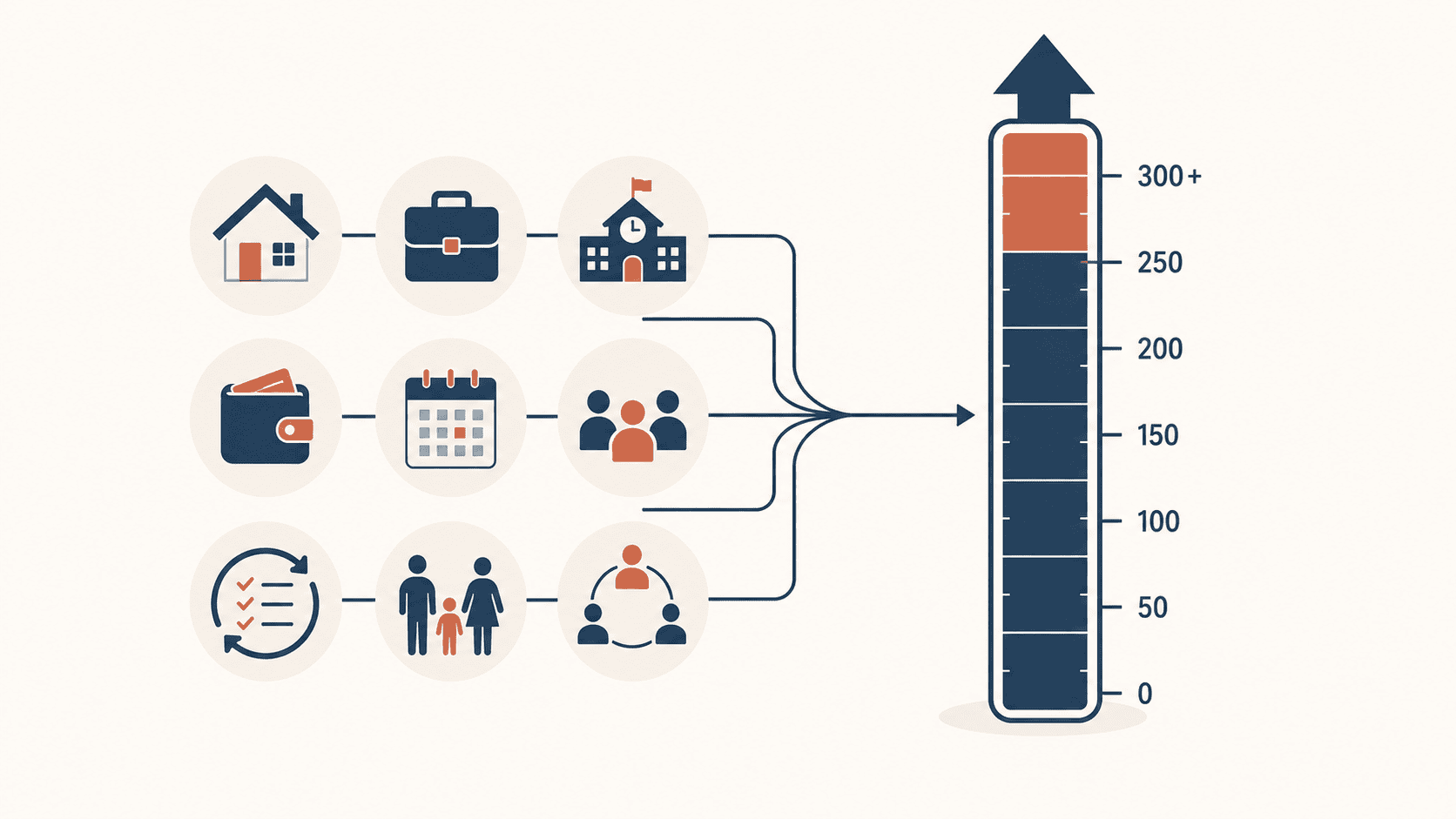
Treat The Move As A Portfolio, Not An Event
If relocation stress is additive rather than singular, the fix is not one grand gesture. It is reducing the number of simultaneous open items an employee is carrying at any given time.
- Sequence the move rather than launching everything on day one. Housing, schooling, banking and social integration do not need to land in the same week.
- Ask new hires and transferees directly which of the eight or nine stacked changes will hit hardest for their specific family, rather than assuming a standard policy covers it.
- Build a genuine check-in cadence after arrival, not just before departure, since stacked stress tends to peak weeks after the move, not on moving day itself.
Relocation is not one dramatic life event. It is a portfolio of ordinary ones landing at the same time, and portfolios need active management, not a single policy document.

Pinewood Relocations sequences every stage of a move, housing, schooling, banking, and settling in, so employees never face more than one major change at once, precisely the stacking effect this article describes. Get in touch to review how your relocation policy manages simultaneous change.