


Mobility Teams Ranked Cost Cutting Dead Last. Finance Did Not Notice.
New 2026 data shows the people running mobility programmes are not the ones pushing for benefit caps and cut price tenders. Here is who actually is, and the evidence to bring to that conversation.
Every mobility manager reading this has had the conversation. Finance sees the top line number on a relocation programme and asks why it cannot be retendered to a cheaper provider. The instinct feels responsible. The 2026 data suggests it is usually the opposite.
The average total cost of a single failed international assignment, roughly four times the typical $77,000 cost of the assignment itself.
GTN Global Mobility Trends Report, xpath.global, 2026
The Cuts Are Coming From Outside The Function
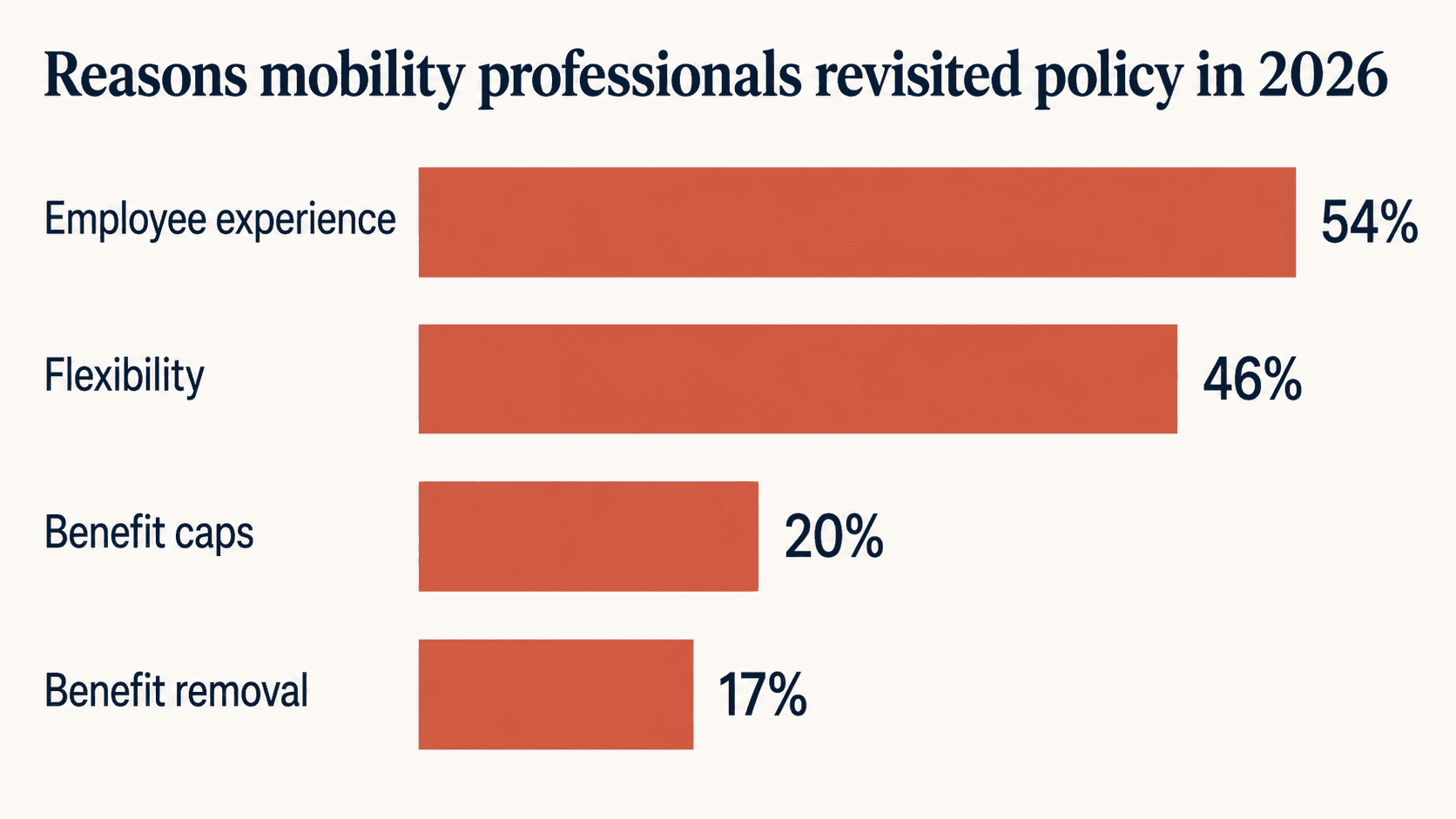
Practitioners are not choosing cost reduction as their main policy lever this year. Only 20 percent cited benefit caps and 17 percent cited benefit removal as reasons for revisiting policy, both trailing far behind employee experience and flexibility. That gap tells you the push to retender on price is coming from finance and leadership reading a single line item, not from the people who see what a bad vendor swap actually costs downstream.
- Cost reduction through benefit caps ranks fourth among reasons mobility professionals are revisiting policy in 2026, at 20 percent.
- Cost reduction through benefit removal ranks last, at 17 percent, behind employee experience at 54 percent and flexibility at 46 percent.
- Procurement research shows cost focused, spreadsheet driven RFPs consistently deliver worse vendor fit and lower employee satisfaction scores than approaches weighting agility and cultural fit alongside price.
- Managing relocations across multiple vendors chasing the lowest per service cost creates hidden costs that routinely exceed the original budget projection.
Arm Yourself Before The Retender Conversation
You cannot argue against a cost cutting request with a feeling. You need the number that shows what failure actually costs.
- Calculate your own organisation’s cost of a failed assignment, not the industry average, before the next budget meeting.
- Ask any provider bidding on price alone to show their assignment completion rate, not just their fee schedule.
- Bring the 54 percent employee experience figure into the room as evidence that your own peers are prioritising retention over headline savings.
A cheap tender is not a cost saving until you know what it does to your completion rate. Ask any provider bidding on price alone what happens to their numbers when things go wrong, because that is the bill finance never sees coming.

Pinewood builds cost visibility into every stage of the mobility lifecycle, so clients can see the real tradeoff before a retender decision is made, not after an assignment fails. Get in touch to review what full cost visibility would show in your programme.