


Flexible Assignments Are Not Replacing Anything. They Are Piling Up.
Every report this year claims short-term, commuter and virtual mobility are replacing traditional expat packages. The industry’s own benchmarking data says the opposite is happening.
If your leadership has told you flexible assignment models are simplifying the mobility function, expecting compliance load and headcount pressure to ease as a result, the data says to expect the opposite outcome this year.
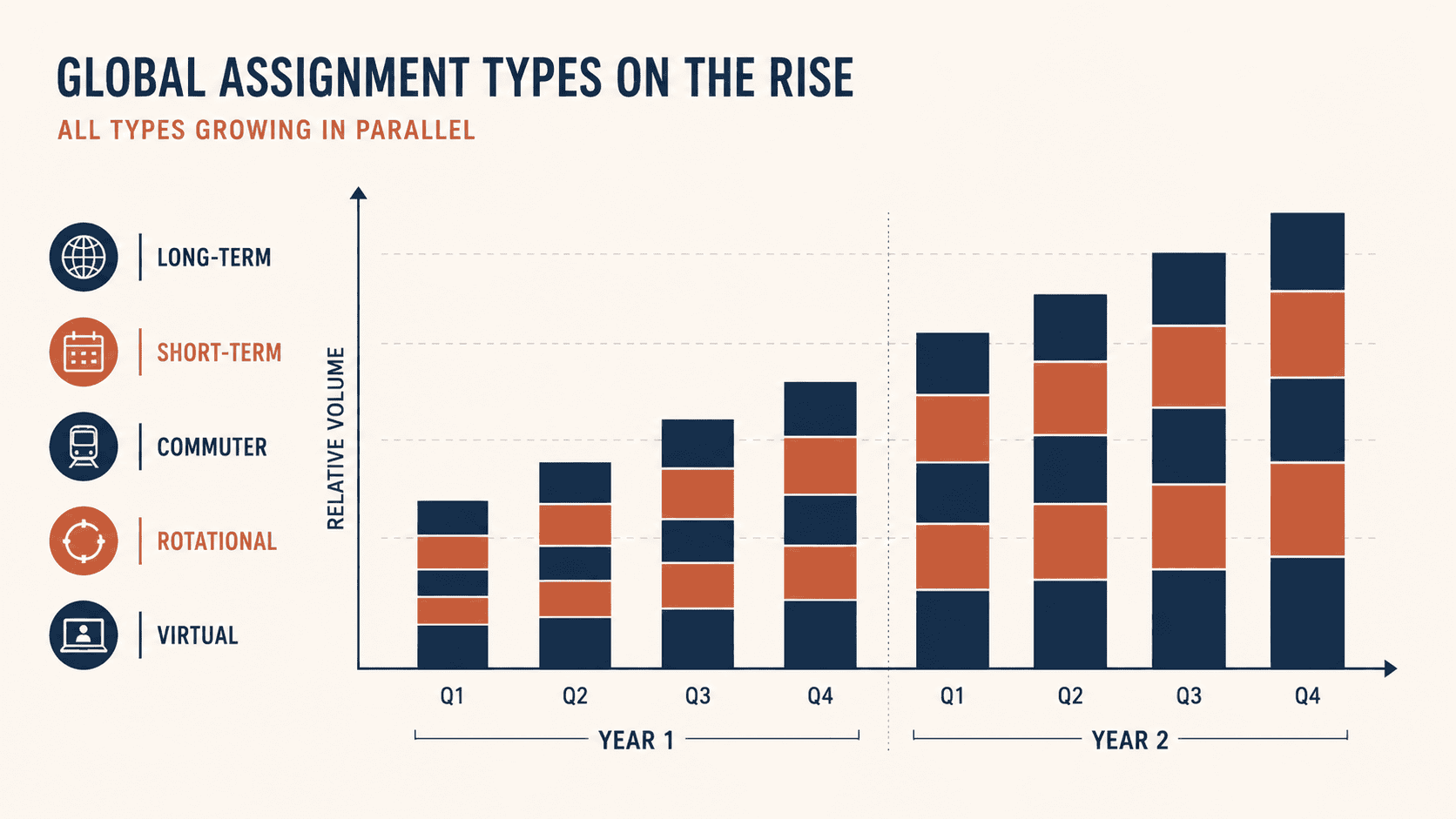
The number of distinct assignment types many mobility teams now run in parallel, long-term, short-term, commuter, rotational and virtual, rather than one model replacing another.
ECA International, LARM Group, 2026
Addition, Not Substitution
The replacement narrative assumes companies are swapping one model for another as needs change. ECA’s data shows something structurally different, organisations are keeping long-term assignments at the core of their programmes while adding every new model on top, each with its own tax treatment, compliance obligations and support structure.
- Long-term assignments have grown as a share of overall mobility populations across most regions in the past two years, not shrunk, despite the prevailing industry narrative.
- Short-term assignment numbers are also rising, with more than half of surveyed companies expecting further growth in the next two years on top of existing long-term volumes.
- Cost containment has resurged as the top concern for managing short-term assignments specifically, after dropping down the priority list in the previous survey cycle.
- Only around a third of companies extend accompanied support to short-term assignees, while 14 percent state explicitly that partner or family support is not the company’s responsibility on these move types.
Budget For Complexity, Not Simplicity
If five or six models are running simultaneously, the mobility function needs to be resourced for parallel complexity, not a leaner single track programme.
- Audit how many distinct assignment types your organisation currently manages before the next budget cycle, rather than assuming the mix has narrowed.
- Push back on any headcount or resourcing plan that assumes flexible models reduce administrative load, since the data shows they add to it.
- Clarify accompanied family support policy for short-term and commuter assignees specifically, since most companies currently leave this undefined or explicitly excluded.
Flexible assignment models have not simplified this profession. They have multiplied the number of frameworks a mobility team runs at once, and any plan built on the opposite assumption is already out of date.

Pinewood builds distinct, properly resourced support structures for each assignment type a client runs, rather than stretching one policy across a portfolio it was never designed for. Get in touch to review how many assignment types your programme is actually managing.