


Your Summer Moves Just Got More Expensive. Permanently.
Peak season is here. What most HR teams do not yet know is that a law signed on 4 July 2025 has quietly changed the cost of every relocation on their programme.
Peak season is not news to anyone in mobility. What is news is the financial context around it in 2026. The One Big Beautiful Bill Act, signed into law on 4 July 2025, permanently eliminated the moving expense deduction for civilian employees in the United States. What was supposed to expire at the end of 2025 is now permanent. The industry lobbied hard against it. Congress did not move.
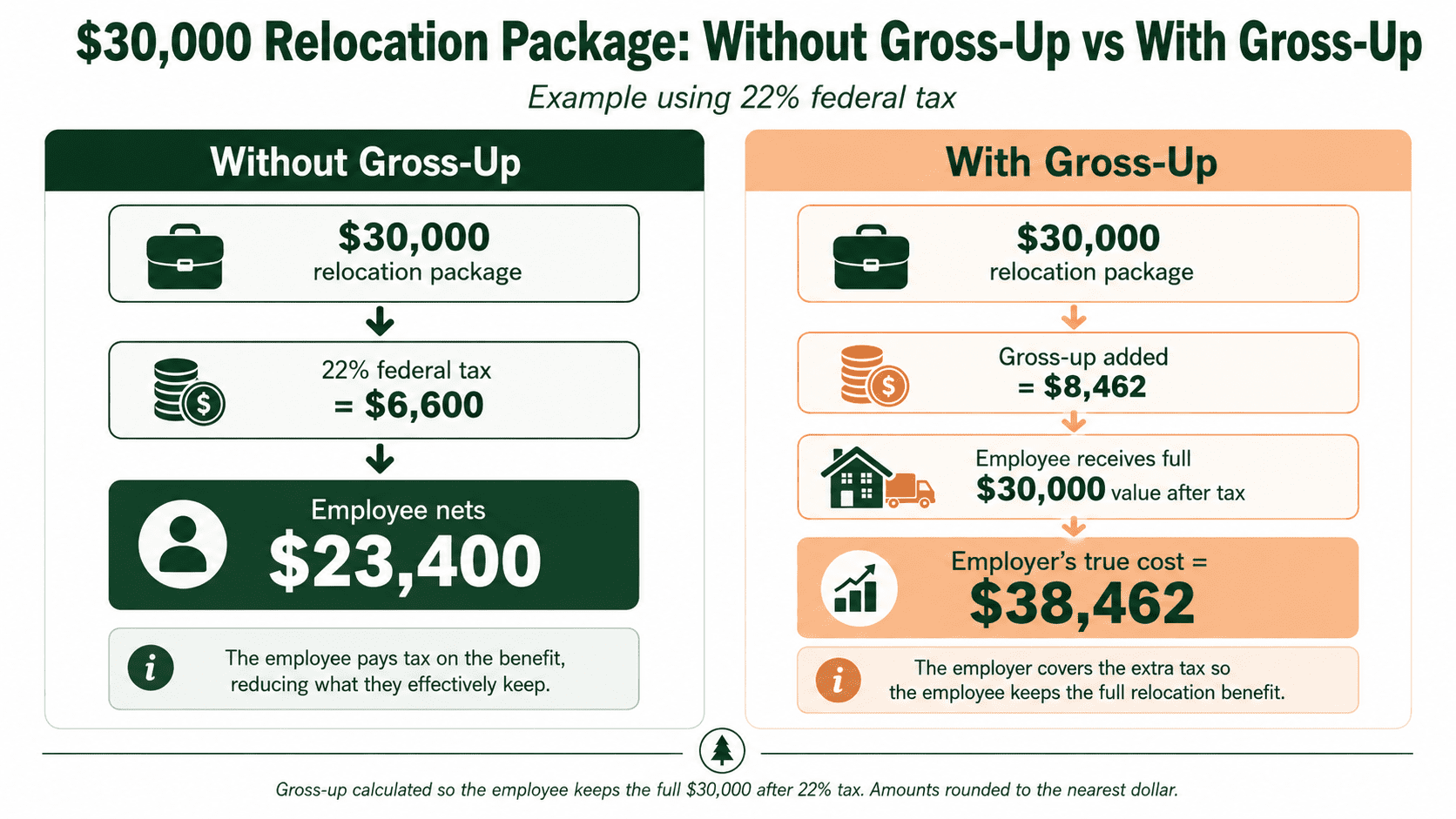
The practical consequence is straightforward and significant. Every dollar an employer reimburses for a move is now reported as fully taxable wages on the employee’s W-2, subject to federal withholding at 22% plus FICA taxes. A relocation package worth $30,000 now requires a gross payment of over $42,000 for the employee to receive the same net benefit. This is not a temporary problem to manage around. It is the new permanent arithmetic of US corporate relocation.
Gross payment now required to deliver a $30,000 net relocation benefit to a US employee in the 24% federal tax bracket.
Kona HR Tax Analysis, 2026
What this means right now, in peak season
For HR and mobility managers with US moves on their programme this summer, three things need attention immediately.
- Review every US relocation package for gross-up. If your policy does not currently include a tax gross-up for relocation costs, your employees are absorbing a significant unexpected tax liability this year. 53% of employers now provide this benefit. If yours does not, your relocating employees will discover the gap when they file their returns in April 2027.
- Recalculate your summer budget. If your cost-per-move modelling was built on pre-July 2025 assumptions, the gross-up requirement alone will have broken it. Mobility programmes that have not run updated numbers are carrying unrecognised budget exposure right now.
- Communicate before employees ask. A relocating employee who discovers a surprise tax bill without warning will attribute it to a failure by HR. A brief, clear explanation sent before the move protects the relationship and demonstrates that the mobility function is on top of its brief.
The seasonal pressures that have not changed
Beyond the tax change, the operational pressures of summer 2026 are consistent with recent years but tighter. Mover availability is constrained globally, with peak season demand absorbing capacity that was already reduced by fuel cost increases. Temporary housing, as covered elsewhere in this issue, is under pressure from competing demand pools. And the July to August window sits inside a period when decision-makers at client companies take annual leave, slowing approvals at precisely the moment mobility teams need them fastest.
- Moves planned for August with approvals outstanding in July are high-risk. Flag these to line managers now.
- Mover quotes from spring are likely out of date. Peak surcharges apply from June and should be confirmed before the move is booked.
- Temporary housing booked as a fallback rather than a planned first step will be harder and more expensive to secure in July and August than at any other point in the year.
The bottom line
AI has not arrived in global mobility. It arrived in global mobility enforcement years ago, and governments have been building capability ever since. The mobility teams whose organisations are exposed are not the ones without AI tools. They are the ones who have not yet acknowledged that the compliance landscape changed while the industry was debating whether chatbots could write assignment letters.

Pinewood Relocations works with clients to identify compliance exposure across their mobile workforce, including business travel populations that sit outside the formal mobility programme. If your organisation does not currently have visibility of where your employees are and how many days they have spent in each jurisdiction this year, that conversation needs to happen now.